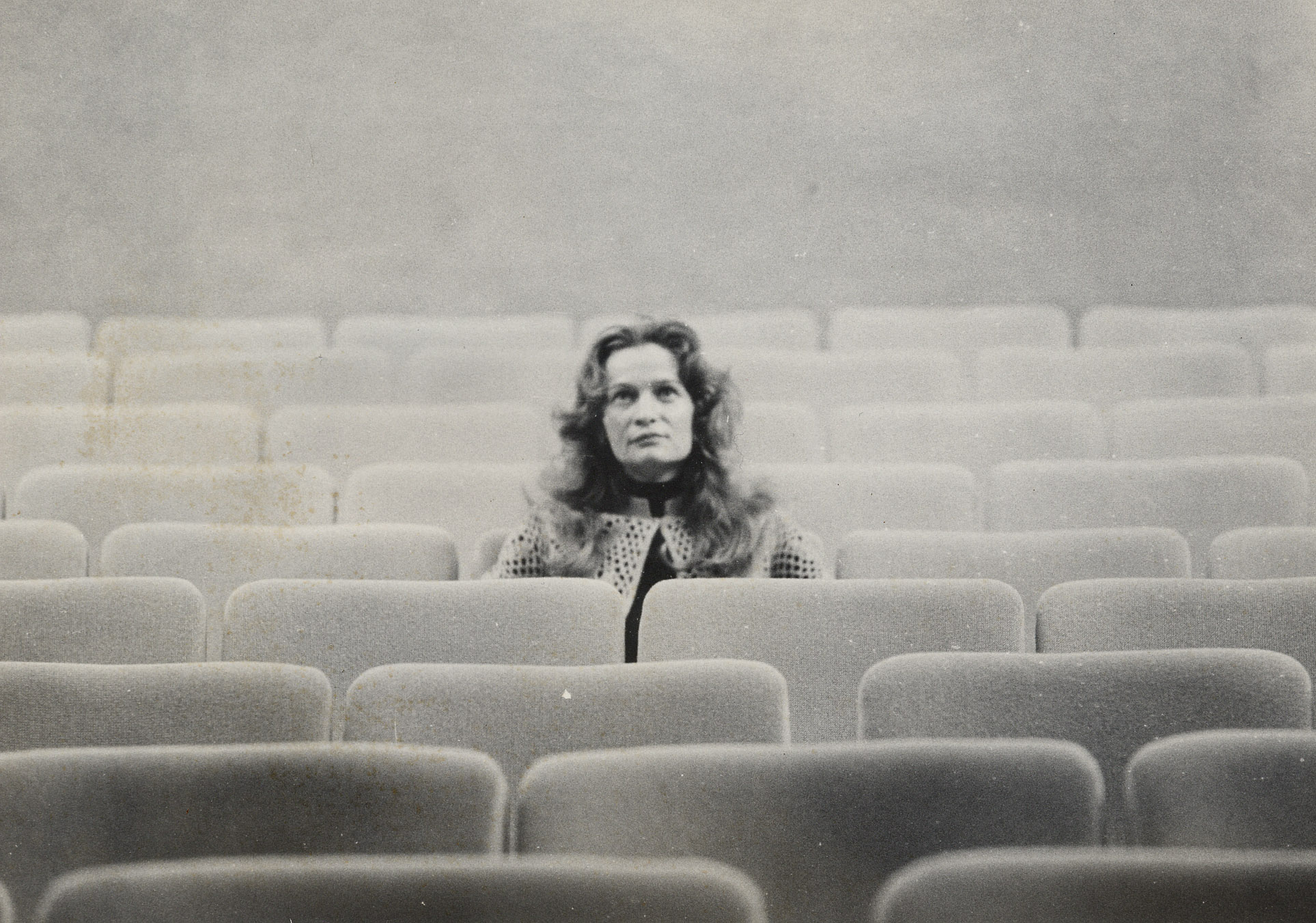
Between 1968 and 1999, French composer Éliane Radigue (1932–2026) created over thirty works for magnetic tape, primarily using the ARP 2500 synthesizer, before shifting her focus to collaborations with instrumentalists. Her electronic compositions constitute a singular body of work that examines the fundamental unrepeatability of perceptual experience.
As of fall 2025, Blank Forms will represent and oversee the live concerts and installations for Radigue’s electronic compositions created for magnetic tape, in partnership with François J. Bonnet and Ina GRM–Groupe de Recherches Musicales. Since 2019, Blank Forms has collaborated with Radigue and Charles Curtis to produce analog editions of these works on magnetic tape and to present them in concert under the same conditions in which she historically premiered them. Overseeing the representation and distribution of Radigue’s oeuvre will ensure future performances align with the composer’s intent, whether realized in the original analog medium or via high-resolution digital playback. The works will be available for diffusion in concert settings with technical setup and playback instructions, through Blank Forms in North America and through Ina GRM in Europe.
Currently, Vice-Versa, etc… (1970), Chry-ptus (1971), Adnos I–III (1974–82), and Trilogie de la mort (1985–93)—including Kyema, Kailasha, and Koumé—are offered for live performance as a set or as individual pieces, using newly produced reel-to-reel editions of the original masters or high-resolution digital files. The remaining compositions are available for high-resolution digital playback and will become available as reel-to-reel editions over the next three years. Limited numbered editions, authorized by Radigue, will be available for institutional placement.
Éliane Radigue (1932–2026) was a pioneering French composer whose music is marked by patient, virtually imperceptible transformations that reveal the radiant internal features of minimal sound—its partials, harmonics, subharmonics and inherent distortions. As a student and assistant to musique concrète pioneers Pierre Schaeffer and Pierre Henry in the ’50s and ’60s, Radigue mastered tape-splicing techniques, but preferred the creation of fluid, delicately balanced feedback works to the spasmodic dissonance of her teachers’ music. Finding peers among minimalist composers in America, Radigue began working with synthesis in 1970, eventually discovering the ARP 2500 synthesizer, which she would use exclusively for her celebrated electronic works to come. With remarkable restraint, Radigue spent years on each piece, painstakingly assembling series of subtle, pulsating ARP recordings, which she would later mix into hourlong suites of precise, durational mutation, including masterpieces Trilogie de la mort and Adnos I-III. In 2001, Radigue adapted an early feedback work, Elemental I (1968), to live performance on electric bass, and in 2004, with the encouragement of ongoing collaborator Charles Curtis, she permanently abandoned electronics for acoustic composition, beginning with Naldjorlak (2006), composed for Curtis on solo cello. Since 2011, Radigue has devoted herself to Occam Ocean, an ongoing cycle of solo and ensemble works composed in close collaboration with individual instrumentalists. In these pieces, the performer’s personal technique and intimate relationship with their instrument become the compositional material itself. As with her earlier work, Radigue maintains an unwavering focus on the materiality of sound, a lifelong commitment that has earned her numerous accolades and affirmed her place as one of the most vital and singular composers of our time.
List of works
All works are available as high-resolution digital files for live performance. Works are linked below as they become available on reel-to-reel tape editions of the original. Please contact radigue.tapes@blankforms.org if you are interested in organizing a presentation of this work.
-
Jouet electronique (1967)
-
Elemental I (1968)
-
Usral (1969)
-
Stress-Osaka (1969)
-
In Memoriam –Ostinato (1969)
-
Labyrinthe Sonore (1970)
-
Omnht (1970)
-
Opus 17 (1970)
-
7th Birth (1970)
-
Geelriandre (1972)
-
Ψ 847 (1973)
-
Arthesis (1973)
-
Biogenesis (1973)
-
Transamorem–Transmortem (1973)
-
Schlinen (1974)
-
Triptych (1978)
-
Les Chants de Milarepa (1983)
-
Jetsun Mila (1986)
-
Trilogie de la mort [Kyema (1988), Kailasha (1991), Koumé (1993)] (1988–93)
-
Danse des Dakinis [Pour Marion] (1998)
-
Île Re-Sonante (2000)
Vice Versa, etc… (1970)
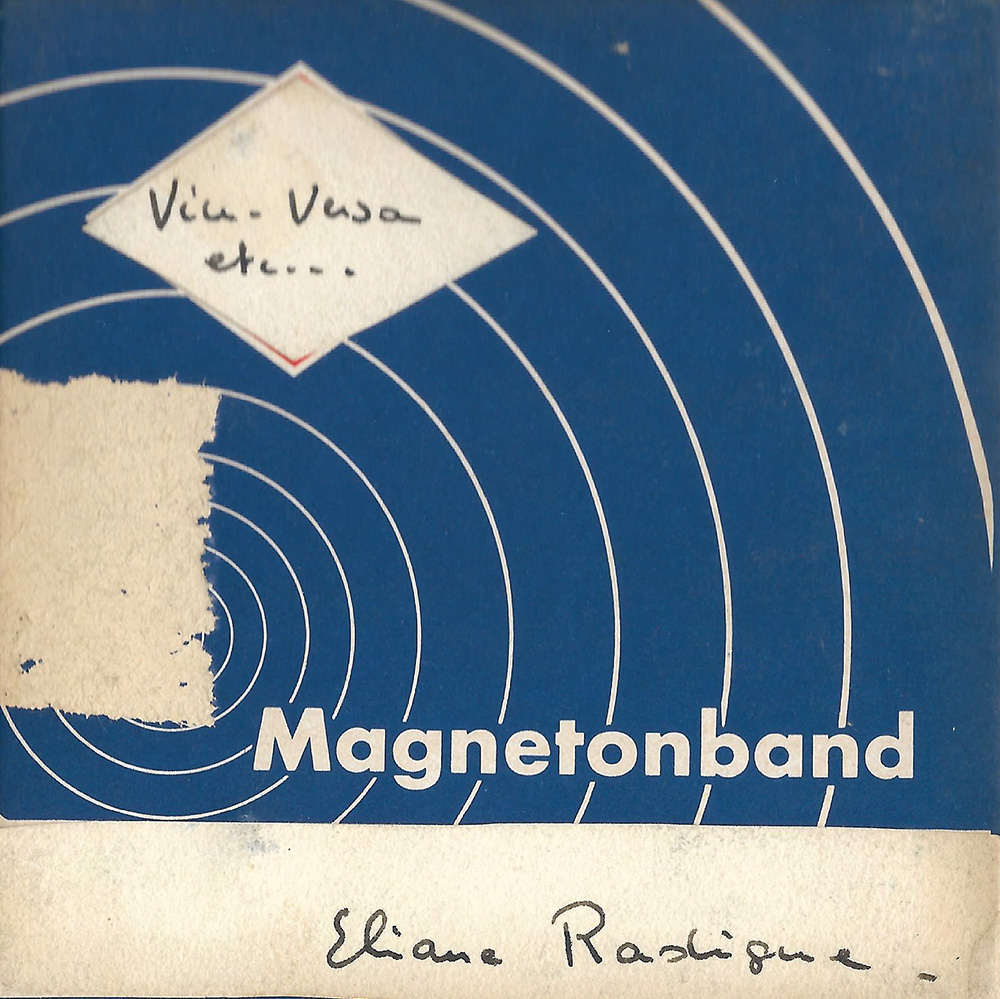
Between 1968 and 1970, Éliane Radigue created a series of variable, combinatory works in her home studio in Paris: Usral, Omnht, Σ = a = b = a + b, and Vice-Versa, etc…, all made with three tape recorders, a mixing board, an amplifier, two loudspeakers, and a microphone. Radigue captured the sonic feedback, reworked it in the studio—slowing some segments down and reversing the direction of others—and recorded the result onto magnetic tape meant for simultaneous playback in loops of different durations. Anticipating the emerging practice of sound installation, she then presented these eternally mutating works under the title of Propositions Sonores in museums and galleries.
Created in 1970 in an edition of ten for the Lara Vincy Gallery in Paris, Vice-Versa, etc… was Radigue’s final feedback composition. It consists of a single magnetic stereo tape with handwritten instructions for diffusion, which suggest that any combination of channels—right channel alone, left channel alone, or both channels together—can be overlapped on several recorders, at any playback speed, forward or backward, ad libitum.
Chry-ptus (1971)

Chry-ptus is Radigue’s first piece created with a synthesizer, a Buchla 100 modular system that had been installed by Morton Subotnick at NYU, and which Radigue shared with Laurie Spiegel. Although seduced by the fact that the Buchla had no keyboard, Radigue was at first frustrated with the instrument’s effervescent output; she spent her initial months eliminating vast ranges of unwanted sounds before finding a small sonic zone she could use as an extension of her prior output. Transferring the delicate touch of her work with feedback to the Buchla’s beautifully rich sonority, Radigue worked with patches and potentiometers to create morphing textures that transitioned from fluttering beats to sustained low frequency tones and back again. In keeping with her earlier sound installation works, Chry-ptus was made with two reels of magnetic tape, to be played simultaneously through four loudspeakers with up to one minute of desynchronization—essentially a canon at the unison. This subtle lapse produces tiny palpitations and new harmonic interplay, yielding a variable music that is never exactly the same nor entirely different. Chry-ptus was first presented in three variations on April 6th, 1971, in the auditorium of the New York Cultural Center.
Adnos I–III (1974–82)
In the conch formed by the flow of sounds, the ear filters, selects, privileges, as would an eye fixed on shimmering water. Only listening is required, like a gaze that is absent and double, oriented toward an exterior image that lives as a reflection in the inner universe.
—Éliane Radigue
Created in three seventy-plus minute parts between 1973 and 1982, Adnos I-III is the first major large-scale work of Radigue’s electronic period and—with Trilogie de la mort—one of two ambitious trilogies recorded at the composer’s home studio in Paris with the ARP 2500 and magnetic tape. A departure from the combinatory pieces of her early period, the Adnos trilogy plunges its listeners into the fathomless depths and unprecedented durations that would come to define Radigue’s late style. The immersive psychoacoustic effects of Adnos I-III extend the limitless qualities of Radigue’s earlier installation work by allowing each listener to create their own subjective experience of the piece based upon spatial orientation and perceptual focus.
The series also represents a pivotal moment in Radigue’s biography. Having completed the mix for Adnos I at GERM, Groupe d'Étude et Réalisation Musicales, and premiered the piece in 1974 for the Festival d’Automne in Paris, Radigue was invited by Robert Ashley to present Adnos I at Mills College in 1975. Following the concert, she was approached by a group of young French students who suggested that she was channeling energies beyond herself; they gave her the address of a Tibetan Buddhist center in Paris; soon enough, she became a devotee there and ceased composing. After three years of study, Radigue was prepared to sell her ARP synthesizer and end her music career, but her guru Lama Pawo Rinpoche convinced her of the value of her contributions to music which, he maintained, could be created as an offering. Upon returning to composition, Radigue completed Adnos II, premiering it in 1980 at Mills College. Adnos III (Prélude à Milarepa) premiered in 1982 at the Experimental Intermedia Foundation in New York; it is composed of four continuous movements (“Dans l’Azur,” “Danse des Dakinis,” “Traversée,” and “Ici et maintenant”) and marks the beginning of Radigue’s explicitly Tibetan Buddhist offerings.
Trilogie de la mort [Kyema (1988), Kailasha (1991), Koumé (1993)] (1988–93)
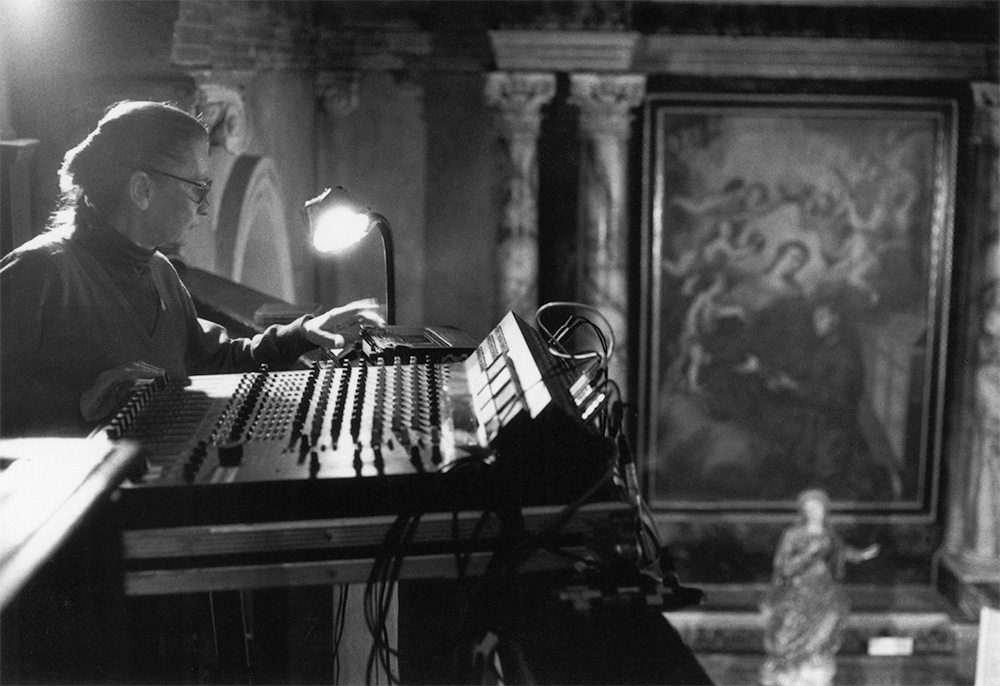
Created between 1988 and 1993, Trilogie de la mort is considered by many to be Éliane Radigue’s masterpiece. An extended sonic meditation on death, informed by Radigue’s dedicated engagement with Tibetan Buddhism, the piece is made up of three hourlong ARP 2500 synthesizer compositions: Kyema, Kailasha, and Koumé. Kyema was inspired by the Bardo Thodol, or Tibetan Book of the Dead; its six sections reflect the six bardos, or intermediate states of life and death which constitute the existential continuity of a being. Shortly after finishing the piece in 1988, Radigue learned of a tragic car accident which took the life of her son Yves. Two weeks later, she began work on Kailasha, named after the sacred Mount Kailash, considered to be the center of the world in Tibetan cosmology. Although Radigue was not able to visit the actual mountain, the piece functions both as a sonic pilgrimage and a memorial to her deceased son; it was completed in 1991. She completed the trilogy in 1993 with Koumé, inspired in part by a trip to Nepal for the cremation of her Tibetan master, which convinced Radigue of the transcendental aspect of death as part of a perpetual becoming. The complete Trilogie de la Mort premiered in November 1993 at the monastery at Cimiez in Nice, where the sound from hidden loudspeakers, according to minimalist composer Tom Johnson, seemed to ooze out of the walls.