Yoshi Wada: Earth Horns with Electronic Drone
Yoshi Wada: Earth Horns with Electronic Drone
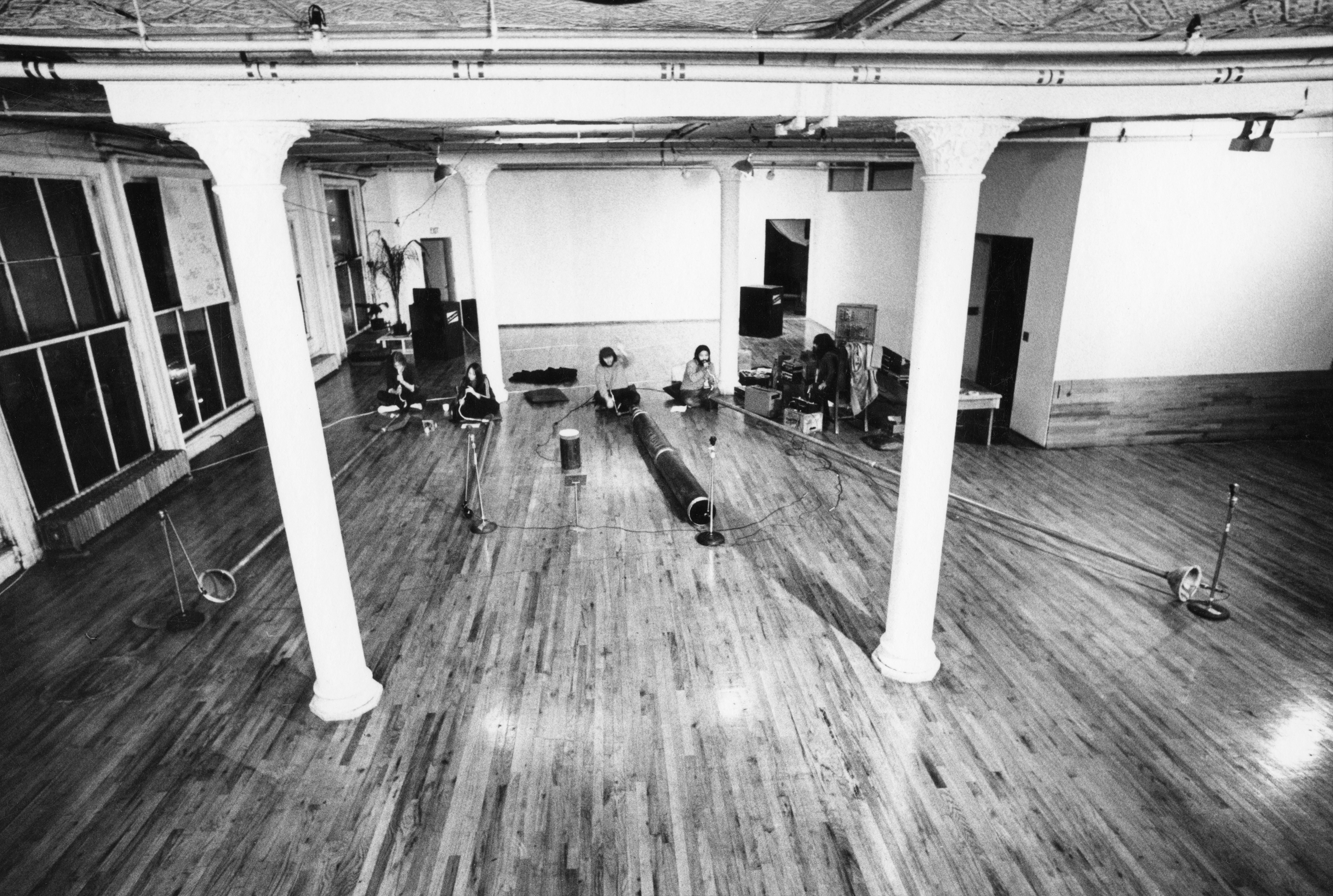
Earth Horns with Electronic Drone performance at The Kitchen, New York, January 1974. Photo by Seiji Kakizaki.
Bourse de Commerce - Pinault Collection
75001 Paris, France
Yoshi Wada arrived in New York from Kyoto in 1967, entering the downtown scene after Terry Riley, La Monte Young, Steve Reich, and Philip Glass had staked out their positions, but before critics subsumed their diverse practices under the catchall of musical minimalism. Instead, their heterogeneous compositions were described as hypnotic, static, or microscopic, terms that aptly capture their defamiliarization of time, space, and scale. Wada, a sculptor by training, arrived at composition obliquely, drawn to the materiality of instrument and environment. Influenced by his diverse studies—with Fluxus founder George Maciunius, composer La Monte Young, vocalist Pandit Pran Nath, and Scottish bagpipers James McIntosh and Nancy Crutcher—he began building instruments out of everyday materials, allowing the sculptural and sonic qualities of his creations to inform and determine one another.
The first of these instruments, constructed in the early 1970s, were the Pipe Horns, constructed of plumbing materials and reminiscent of oversized Tibetan and Alpine horns. The largest were over thirty feet long and up to ten inches in diameter; their sound was ominously panoramic. In 1974, at the newly established experimental institution The Kitchen, Wada combined these instruments with synthesizer electronics in a performance dubbed Earth Horns with Electronic Drone. In the decades since, over the course of rewritings and global restagings, Earth Horns has become known as a masterpiece of second-generation minimalism and durational composition.
During each performance, pipers sustain various deep tones for shifting lengths of time, allowing the horns—which, like the modular electronics system, have been tuned to the frequencies of the room—to merge and diverge imperceptibly. Meanwhile, the electronic system processes the real-time acoustic activity of the pipe horns and outputs a continually modulating drone, which folds into the room’s further acoustic cycles. In this dynamic sound environment, the primordial sounds of the pipe horns are contrasted with and transformed by the purity of the electronic tones; the piece is remarkably organic in structure and timbre, contrary to the cool, artificial remove sometimes attributed to the minimalism of his peers. “All changes become modulations of a single resonating acoustic environment,” wrote Yoshi Wada in the program notes for the original performance in 1974. “I am most interested in the effect, psychologically, of these subtle tones and movements on both players and audience alike, particularly played, as I plan, over an extended period of time.”
The interactive electronic system, originally designed and built by Liz Phillips in collaboration with Yoshi Wada, has been reconstructed using digital technology by Ezra Buchla in collaboration with Phillips and Tashi Wada.
Composer, artist, and pioneer of minimalist sound Yoshi Wada (1943–2021) was a fixture of New York’s experimental art scene for more than fifty years. His performances and sound installations—filled with traditional and homemade instruments, sound-generating devices, sculptures that make sound, and early computer technology—offered listeners the opportunity to consider what we hear, the way we hear it, and the meaning of hearing. Wada has remained an important and widely influential figure for generations of artists and musicians. In the last decade of his life, Wada collaborated extensively with his son, composer and musician Tashi Wada, who now oversees his estate and archive.
Tashi Wada is a composer and performer based in Los Angeles. Wada studied composition at CalArts with James Tenney, and for many years performed alongside his father Yoshi Wada. He has presented his music internationally and collaborated with a range of artists including Charles Curtis, Simone Forti, and Julia Holter. Wada founded and runs the label Saltern. His most recent album, What Is Not Strange?, was released in 2024 by RVNG Intl.