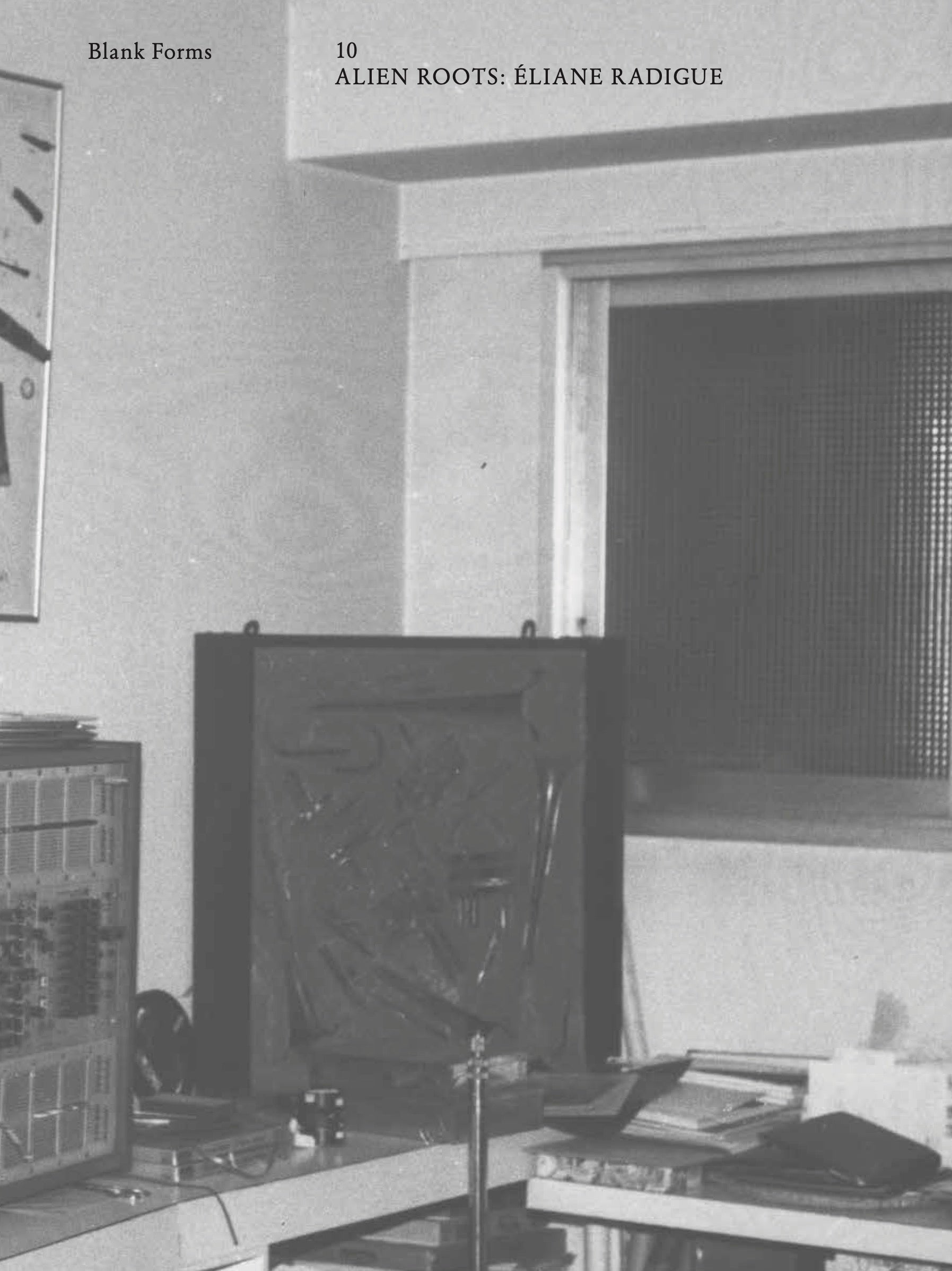
Alien Roots: Éliane Radigue
The tenth and final anthology from Blank Forms explores the early electronic work of French composer Éliane Radigue, whose radical approach to feedback, analog synthesis, and composition on tape has long evaded historical and technical interpretation. Combining key texts, newly translated primary documents, interviews, and commissioned essays, this compendium interrogates the composer’s idiosyncratic compositional practice, which both embraces and confounds the iterative nature of magnetic tape, the subtleties of amplification, and the very experience of listening.
Among these entries is an in-depth overview by cellist Charles Curtis, a close collaborator of Radigue’s, examining the composer’s earliest experiments with feedback techniques and analog synthesis, her eventual shift to composing for unamplified instruments and live performers, and her unique aesthetic configurations of time and presence. A number of detailed conversations between the composer and researchers Georges Haessig, Patrick de Haas, Ian Nagoski, and Bernard Girard provide crucial insights into her working methods at different points throughout her career. Religious studies scholar Dagmar Schwerk reflects upon Radigue’s profound synthesizer work Trilogie de la Mort (1988–93) in the context of Tibetan Buddhist thought and its history, while texts by musicians Daniel Silliman and Madison Greenstone examine, in notably different ways, the technical characteristics of Radigue’s sound practice. Sketches for unrealized work, contemporary reviews, concert programs, and other ephemera mapping the performance history of Radigue’s early work are presented together for the first time. The anthology concludes with a roundtable discussion between Curtis, Greenstone, and Anthony Vine, untangling the knot of paradoxes at the center of Radigue’s artistic practice to trace the thread of her continued “ethos of resistance.”
“This beautifully presented anthology highlights the considerable contribution made by Radigue to tape and electronic music and the international reach of her work. It will be both an essential reference source for scholars and a treasure trove for enthusiasts to dip into.”
TEMPO
“Éliane Radigue is one of the great twentieth-century artists because she embodies the optimism of modernism while using technologies like the oscillator and magnetic recording tape that obliterated the nineteenth-century approaches designed for stringed instruments and concert halls (things she also loves). Radigue is, more or less, the living dialectic of amplified music.”
4Columns
“Comprising a wealth of material that offers unprecedented access and insight into the working methods, history of activities, and ideas surrounding the work of arguably the most important composer working today, Alien Roots: Éliane Radigue is as good as publications attending to experimental music get. Impossible to recommend enough.”
SoundOhm
“Radigue’s music is somehow simultaneously scientific and animistic, a dialectic that is illustrated beautifully in Curtis and Silliman’s essays. Her compositions are made up of a subtle but lively dance between a minimal set of sounds, micro-events called ‘beating patterns,’ which are created by the interplay of closely tuned frequencies. ... Much attention is also paid to each sound’s lifespan, rising carefully from silence and cross-fading with other sounds before passing again into silence. As you listen, your attention becomes more attuned to its birth, life, and death; it's like listening closely to breathing. ... This is music that drills into the psyche of the listener to permanently change how that person understands sound.”
The Nation