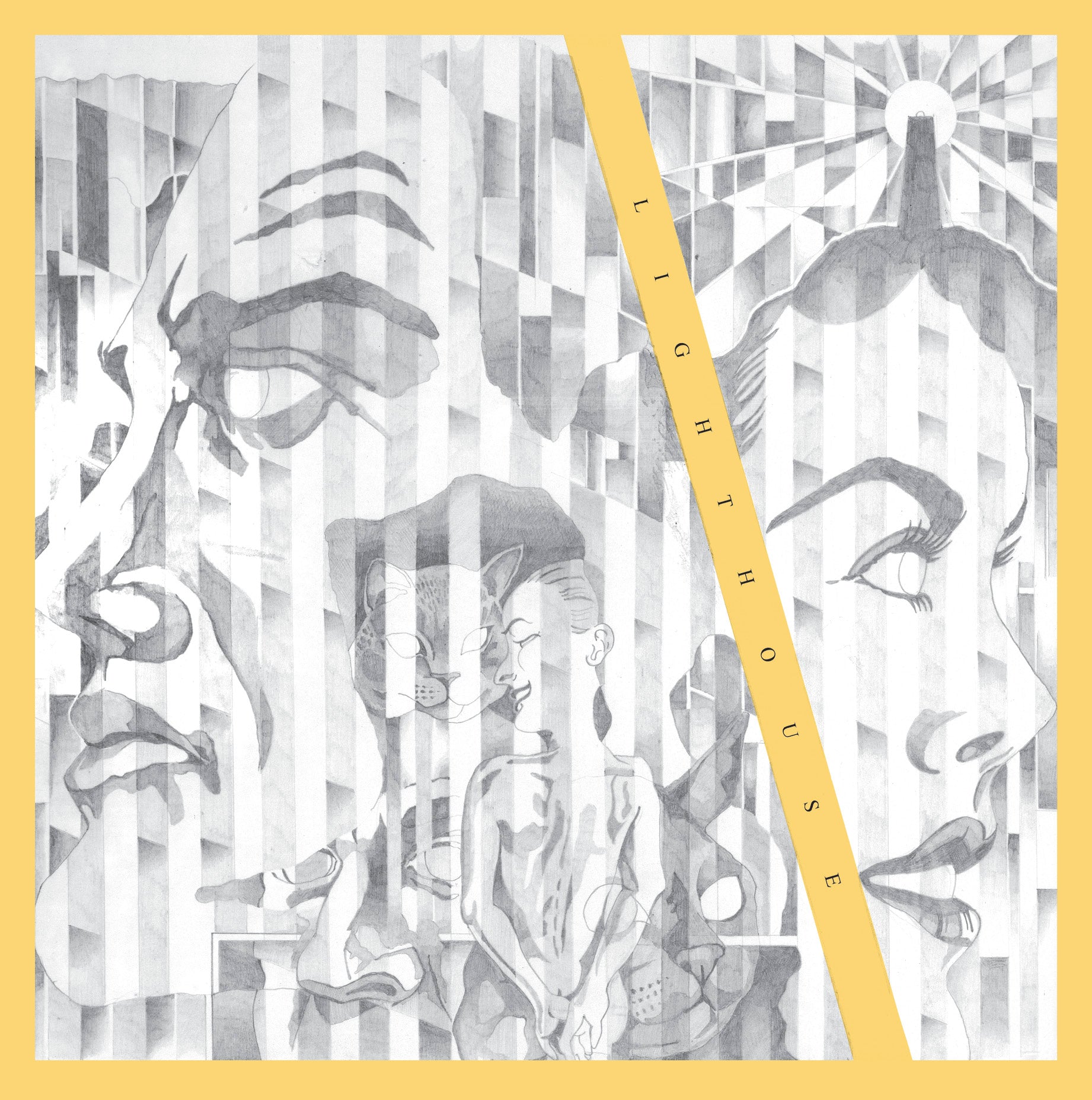
The Shadow Ring: Lighthouse
“I don’t look at it as loneliness, I look at it as solitude.”
Recorded in 1997, on The Shadow Ring’s return from their final American tour, Lighthouse captures the group at their most stripped-down and visionary. Graham Lambkin’s fractured texts conjure Folkestone’s haunted coastline—Vikings, the Morgawr, a fading Britain, the pull of the sea—under the sway of Alternative TV’s Vibing Up the Senile Man (Part One), the mechanical vernaculars of Robert Ashley, and the deflated humor of Dad’s Army and It Ain’t Half Hot Mum.
Opening the trio’s famed final phase (documented across three releases on Scott Foust’s Swill Radio), Lighthouse finds The Shadow Ring turning away from the glare of the stage and the restlessness of the road. Retreating into the domestic seclusion of Coombe House, they work with field recording and kitchen-table musique concrète, attending closely to the internal structure of each track. Scott Foust, Karla Borecky, and Adris Hoyos—newly installed at Coombe House—all make guest appearances; the latter lends her voice and drums to the D-side, while her newly minted relationship with Graham Lambkin and move to Folkestone haunt the record’s themes. In the glow of Pebble Mill at One, Lambkin’s language grows increasingly elliptical, mapping ancient hills and seascapes while gazing outward across the Channel.
A sustained exchange between Lambkin and Foust encouraged a hermetic approach, pushing further into the lo-fi economy the group had once pursued tentatively, in the shadow of figures like Marc Bolan and David Bowie. Embracing an aesthetic poverty, they turned now toward the spare, conceptual rigor of Robert Ashley and Alvin Lucier, deepening Lambkin’s investment in bedroom-studio production. On Lighthouse, each piece emerges as a self-contained construction—an austere form governed by its own logical constraints. Like the decommissioned beacon of its title, the album inhabits the ruins of post-Channel stagnation while conjuring a mythic past, embodying a distinctly British provincialism amid a waning United Kingdom.
While aficionados still regard Lighthouse and its two successors, Lindus and I’m Some Songs, as The Shadow Ring at their peak, Swill Radio’s cultivated obscurity meant few heard them at the time. Darren Harris has since called them the group’s finest work, but noted that the albums received only a single review, written by label boss Scott Foust himself. The world wasn’t yet ready for Lighthouse. Now, twenty-five years on, Blank Forms extends its “flood the zone” reissue campaign with a deluxe edition of this double-LP magnum opus, available again on vinyl.
Throughout their legendary, decade-long run, The Shadow Ring were an enigmatic force on the international musical sub-underground. Before their disbandment in 2002, this shambolic rock outfit, formed by a group of rowdy teenagers in southeast England, left behind a mighty run of eight LPs, a handful of 7"s, and a spate of raucous live shows and cryptic zine appearances on both sides of the Atlantic, all which have bolstered their enduring word-of-mouth mystique. Beginning in 2023 with the first-ever vinyl pressing of the self-released pre–Shadow Ring tape The Cat & Bells Club (1992), Blank Forms Editions has been conducting a systematic retrospective of the storied group. The double LP Lighthouse is the latest release in a multiyear reissue effort that includes several LPs, a comprehensive CD box set, and a nearly five-hundred-page book.