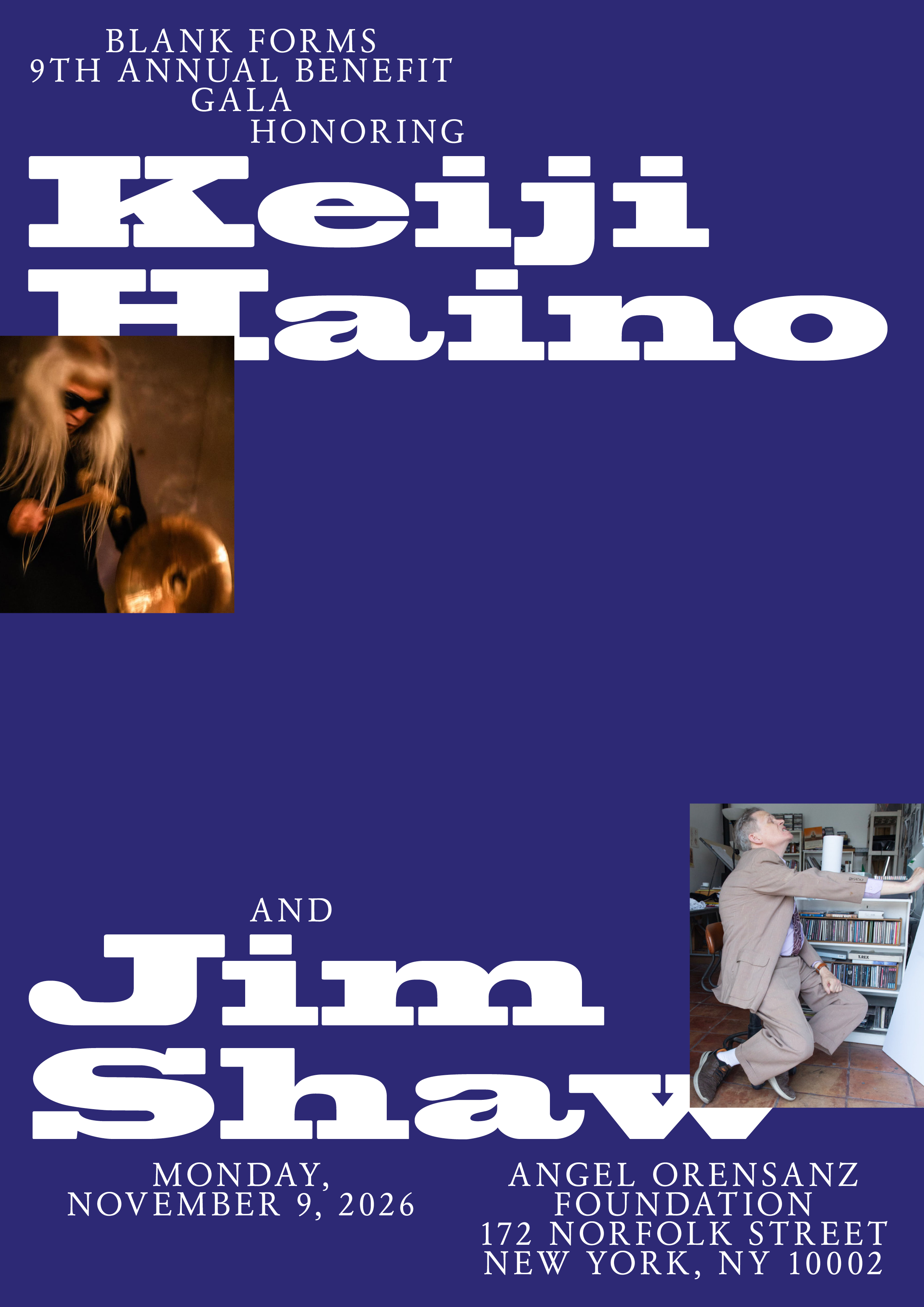
Blank Forms 9th Annual Gala Honoring Keiji Haino and Jim Shaw
The Angel Orensanz Foundation
New York, NY 10002
On Monday, November 9th, Blank Forms presents its ninth annual benefit gala honoring visionary artists Keiji Haino and Jim Shaw. Please join us for cocktails, dinner by Kreung Cambodia, and special performances by Haino-san and others.
Titans of their respective fields, Haino and Shaw epitomize that essence of artistic genius: the ability to assimilate omnivorous tastes and contradictory influences into an unmistakable, singular style. Whether beholding Haino’s bluesy, noisy improvisations or Shaw’s cerebral, facetious dreamscapes, we at Blank Forms honor the decades of insistent experimentation that produced these irreducible bodies of work.
Our yearly gala raises crucial funds for future programs: live performances, exhibitions, archival initiatives, and our publishing imprint, which issues books and records. Blank Forms depends on donor support both to commission new works from emerging artists and to advance the legacies of historically important figures like Maryanne Amacher, Don and Moki Cherry, Catherine Christer Hennix, and Jerry Hunt. To help support and for more information about the event, please contact Corinne Daniel: corinne@blankforms.org.
GALA COMMITTEE: Sarah Arison, Nadia Berenstein and Robbie Lee, James Cahn and Jeremy Collatz, Anthony B. Creamer III, Alexandra Cunningham Cameron, Cheswatyr, Angela Goding, Kim Gordon, Josephine Graf and Joseph Miller-Gamble, Jane Hait and Justin Beal, Laura Hoffman, Sanya Kantarovsky, Ruba Katrib, Jutta Koether, Bernard Francis Kyle, Alex Lau, Cary Loren, Sarah Martin-Nuss and David Nuss, Ryan Muller, Eleanor Heyman Propp, Arlene Shechet, Kim Schnaubert, Stylus and The Limen Foundation, Julia Trotta, Jacques Louis Vidal, Kara Walker and Ari Marcopoulos, Andros Zins-Browne.
Forged in the fevered Japanese underground of the 1970s, in the same cultural ferment as Kaoru Abe and Les Rallizes Dénudés, Keiji Haino remains one of its towering figures: an icon of the scene and one of the greatest living guitarists. Deeply informed by the concept of ma—the negative space in between, or “the deepest now”—Haino’s music vacillates between excess and tranquility, throwing each into stark relief. He describes his approach as nazoranai (“not repeating”), distinguishing it from forms of improvisation that return to familiar motifs; he has said that his aim is to make music so estranging that it falls outside the gaze of God.
Keenly attuned to silence, Haino exhibits a perennial playfulness with rhythm and a patience for sustained irresolution, as well as a penchant for extremes. Bluesy syncopations stutter through the sludgiest, caterwauling licks, suddenly opening onto pockets of deep serenity. The lightest touch produces shock waves, a scream blisters the lungs; moments later, Haino patiently works his way along a single string, yielding delicate slides and vibratos, his voice reduced to breath and murmur. Haino’s formative influences are never far from view: on the one hand, Antonin Artaud’s Theatre of Cruelty, which sought to bypass psychological realism in favor of a primal, convulsive spectacle capable of shocking an audience into a different state of awareness. On the other, The Doors, whose trancelike organ, outsized personas, and yowling confrontation with spiritual darkness offered a stark counterpoint to the utopianism of the hippie era.
In 1970, Haino joined Lost Aaraaff, a percussion-led outfit for which he provided hair-raising, ethereal vocals and, later, an array of instruments he acquired autodidactically, including guitar and saxophone. Touring with Lost Aaraaff, Haino matured quickly, absorbing the influence of such luminaries as Takashi Mizutani, Kaoru Abe, and Masayuki Takayanagi. That same decade, Haino founded his rock band Fushitsusha, and in 1981 released his first solo album, Watashi Dake?, on Takafumi Sato’s now-legendary underground label Pinakotheca. By the end of the decade, Haino had found an important home in Hideo Ikeezumi’s P.S.F. Records, the label and record-shop nexus that became one of the principal conduits for Japan’s underground music. P.S.F. issued Fushitsusha’s first album, a sprawling double-live set, in 1989, followed by Haino’s Nijiumu in 1990 and a stream of recordings that situated his work alongside a remarkable constellation of Japanese psychedelia, free improvisation, folk, and noise.
Alongside Fushitsusha, Haino pursued projects including Vajra with Kan Mikami and Toshiaki Ishizuka, and later Aihiyo, whose radically transformed versions of pop and rock songs extended his practice into an unlikely repertoire of covers. At the same time his work increasingly circulated abroad, through John Zorn’s Avant and Tzadik labels and collaborations with Loren Connors, Alan Licht, Jim O’Rourke, and others. His body of work now spans more than two hundred records in various formations, on which he has explored an extraordinary range of instruments, from guitar and percussion to lute, CDJs, cymbals, and the medieval hand-cranked hurdy-gurdy. At seventy-four, Haino remains as active and uncompromising as ever, performing regularly around the world and continuing to pursue new forms; this year, the Venice Biennale named him the recipient of its Golden Lion for Lifetime Achievement, recognizing more than half a century spent radically expanding the possibilities of sound and performance.
Hailed as a singular chronicler of the American id, Jim Shaw has mined the visual languages of everything from supermarket brands to Scientology to comics and celebrity culture, assembling these heterogeneous influences into a superabundant, surrealist body of work that spans painting, sculpture, collected found objects, and what he terms “conceptual illustration.” A preoccupation with the construction and destruction of myth, broadly defined, pervades. In Shaw’s oeuvre, high-minded religiosity and the primal glamor-lust of advertising are equally freaky and worthy of inquiry. All forms of iconography are available for remixing, stealing, or making grotesque: Wonder Bread meets Stevie Wonder; Botticelli’s Venus overlays the mushroom cloud of a nuclear bomb. Shaw’s are history paintings, brimming with narrative; the story they tell is a paranoid one of a deindividuated everyman whose consciousness is oversaturated by a collective imagery.
Born in Midland, Michigan, in 1952, Shaw connected early on with his lifelong creative collaborator Mike Kelley. The pair staged guerilla performances, advertised as lectures, as undergrads at the University of Michigan; with Cary Loren and Niagara, they co-founded Destroy All Monsters, a proto-punk “anti-band” specializing in noisy amateur soundmaking in wake of The Stooges. Shaw followed Kelley to CalArts, where he studied with John Baldessari and developed an interest in photographic distortion that anticipated his later grotesqueries; after graduating in 1978, he remained in Los Angeles, spending a decade in special effects before the success of My Mirage—his hallucinatory chronicle of postwar American adolescence, religion, drugs, and counterculture—allowed him to devote himself fully to art. While visual art became Shaw’s primary focus, he never stopped making music and has continued to play with members of DAM as well as with Dred Dwarf, with whom he developed a prog rock opera presented at Miami Basel.
Throughout his wildly diverse practice, Shaw has maintained an essential interest in the spiritual and the unconscious; his celebrated Dream Drawings and Dream Objects illustrate his nightly visions with all the frank sexuality Freud predicted, while The Hidden World amasses so-called didactic art, or merchandise propagandizing eccentric ideologies. Shaw has even founded a religion of his own: Oism, a belief system predicated on the worship of the mother O, protector against the evil I. And while his Thrift Store Paintings (a collection, as the name suggests, of paintings bought at thrift stores, garage sales, and flea markets across the country) have often been prized for their insight into the typical American’s aesthetic, Shaw maintains that the works are more representative of psychotic, pathetic self-expressions—anomalies, not averages. By his own proclamation Shaw is drawn to the weird and the cheap, the lasting power of whatever is in terrible taste; perhaps it is no surprise, then, as American politics grows increasingly gaudy, that Shaw’s latest turn is toward the visual punning and satirical fervor of the political cartoon.
Shaw’s work has been featured in the 55th Venice Biennale (2013) and the 1991 and 2002 Whitney Biennials in New York. His work is included in the permanent collections of the Centre Pompidou, Paris; Musée d’Art Moderne et Contemporain, Geneva; Solomon R. Guggenheim Museum, New York; Los Angeles County Museum of Art; Metropolitan Museum of Art, New York; and Whitney Museum of American Art, among others. His parallel musical experiments were later gathered in the eight-CD anthology Solo Works for Electric Guitar, Electronics, and Audiotape 1975–1979, comprising forty-six recordings of psychedelic guitar improvisations, tape cut-ups, loops, and electronic experiments made during and just after his time with Destroy All Monsters.
KREUNG CAMBODIA celebrates the joy of Khmer cuisine. Built on a history of traditional recipe sharing, with dishes steeped in generations of traditional cooking methods, Kreung uses only the best sustainably farmed and foraged local ingredients. Founder and Chef Chinchakriya Un brings her unique approach to Cambodian cuisine through pop-up dinners in cities and spaces all over the world, and her recently opened restaurant BONG in Crown Heights, Brooklyn.
The Angel Orensanz Foundation is wheelchair-accessible via elevator. If you require help accessing the space for any reason, please contact izzy@blankforms.org.




Priority front row table for ten guests with table service, dinner and drinks
Complimentary Blank Forms All-Access membership for two, plus Friend memberships for all guests
Complimentary Blank Forms tote bags and selected 2026 books and records for all guests
Invitations to private Blank Forms events throughout the year
Lead Gala Sponsor listing in print and online
$23,900 tax deductible
Priority table for ten guests with table service, dinner and drinks
Complimentary Blank Forms Friend memberships for all guests
Complimentary Blank Forms tote bags and a copy of Alien Roots: Éliane Radigue for all guests
Invitations to private Blank Forms events throughout the year
Special name recognition on the benefit committee list in print and online
$13,250 tax deductible
Table for ten guests with table service, dinner and drinks
Complimentary Blank Forms All-Access membership for two
Complimentary Blank Forms tote bags and a copy of Alien Roots: Éliane Radigue for all guests
Invitations to private Blank Forms events throughout the year
Name recognition on the benefit committee list in print and online
$8,500 tax deductible
Individual Tickets
$2,500 Honoree Ticket (includes Lead Sponsor Table benefits)
$1,500 Benefactor Ticket (includes Benefactor Table benefits)
$1,000 Patron Ticket (includes Patron Table benefits)
$80/ticket not deductible
Donations
100% tax deductible
*Blank Forms is happy to invite artists and collaborators to join tables with unused seats
**For payments by check (preferred, no fees), please contact Corinne Daniel at corinne@blankforms.org