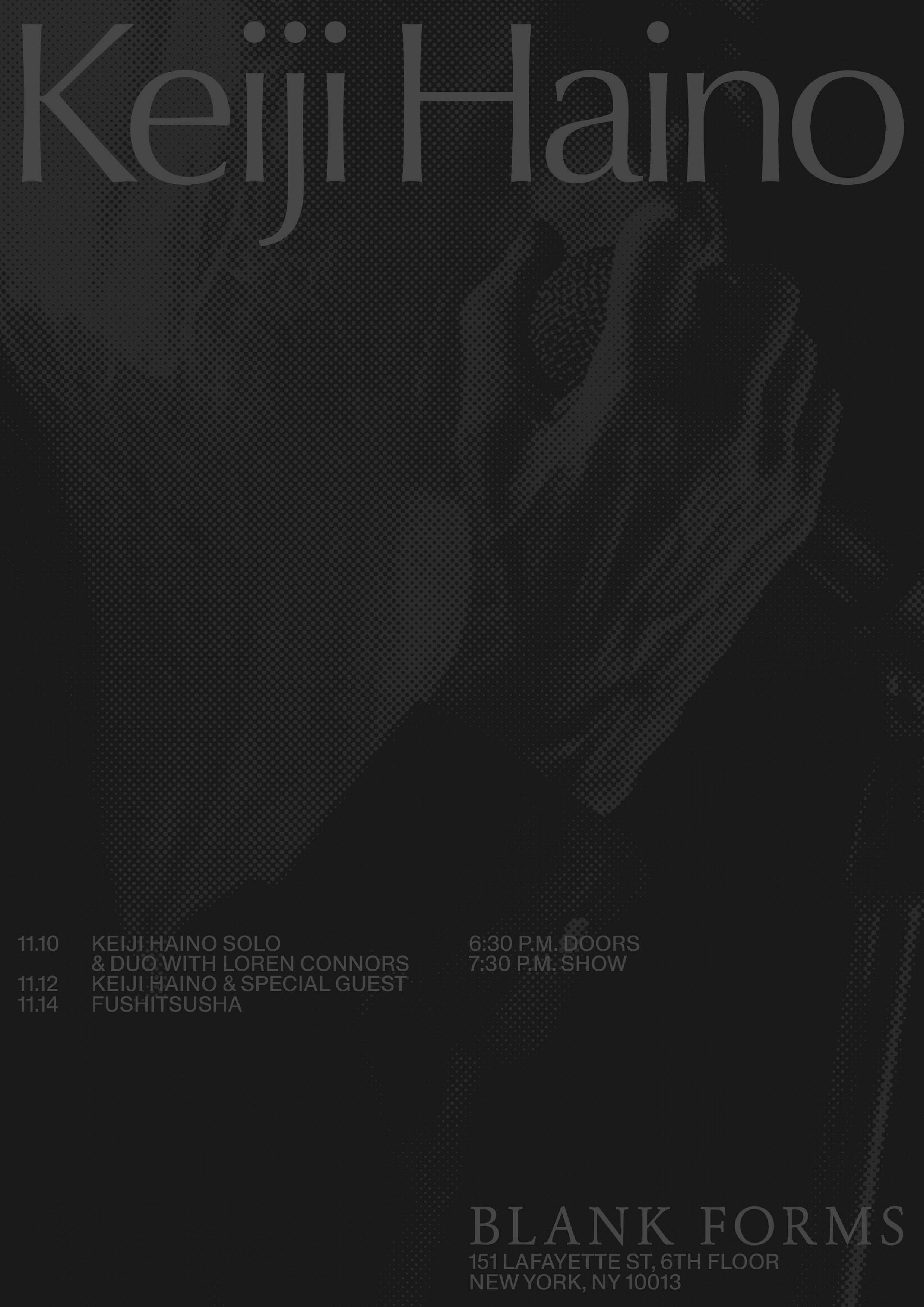
Keiji Haino & special guest
Blank Forms
6th floor
New York, NY 10013
Forged in the fevered Japanese underground of the 1970s, in the same cultural ferment as Kaoru Abe and Les Rallizes Dénudés, Keiji Haino remains one of its towering figures: an icon of the scene and one of the greatest living guitarists. Deeply informed by the concept of ma—the negative space in between, or “the deepest now”—Keiji Haino’s music vacillates between excess and tranquility, throwing each into stark relief. He describes his approach as nazoranai (“not repeating”), distinguishing it from forms of improvisation that return to familiar motifs; he has said that his aim is to make music so estranging that it falls outside the gaze of God. In Haino’s music, there is a playfulness with rhythm and a patience for sustained irresolution, as well as a penchant for extremes. Bluesy syncopations stutter through the sludgiest, caterwauling licks, suddenly opening onto pockets of deep serenity. The lightest touch produces shock waves, a scream blisters the lungs; moments later, Haino patiently works his way along a single string, yielding delicate slides and vibratos, his voice reduced to breath and murmur. Haino’s formative influences are never far from view: on the one hand, Antonin Artaud’s Theatre of Cruelty, which sought to bypass psychological realism in favor of a primal, convulsive spectacle capable of shocking an audience into a different state of awareness. On the other, The Doors, whose trancelike organ, outsized personas, and yowling confrontation with spiritual darkness offered a stark counterpoint to the utopianism of the hippie era.
In 1970, Haino joined Lost Aaraaff, a percussion-led outfit for which he provided hair-raising, ethereal vocals and, later, an array of instruments he acquired autodidactically, including guitar and saxophone. Touring with Lost Aaraaff, Haino matured quickly, absorbing the influence of such luminaries as Takashi Mizutani, Kaoru Abe, and Masayuki Takayanagi. That same decade, Haino founded his rock band Fushitsusha, and in 1981 released his first solo album, Watashi Dake?, on Takafumi Sato’s now-legendary underground label Pinakotheca. By the end of the decade, Haino had found an important home in Hideo Ikeezumi’s P.S.F. Records, the label and record-shop nexus that became one of the principal conduits for Japan’s underground music. P.S.F. issued Fushitsusha’s first album, a sprawling double-live set, in 1989, followed by Haino’s Nijiumu in 1990 and a stream of recordings that situated his work alongside a remarkable constellation of Japanese psychedelia, free improvisation, folk, and noise.
Alongside Fushitsusha, Haino pursued projects including Vajra with Kan Mikami and Toshiaki Ishizuka, and later Aihiyo, whose radically transformed versions of pop and rock songs extended his practice into an unlikely repertoire of covers. At the same time his work increasingly circulated abroad, through John Zorn’s Avant and Tzadik labels and collaborations with Loren Connors, Alan Licht, Jim O’Rourke, and others. His body of work now spans more than two hundred records in various formations, on which he has explored an extraordinary range of instruments, from guitar and percussion to lute, CDJs, cymbals, and the medieval hand-cranked hurdy-gurdy. At seventy-four, Haino remains as active and uncompromising as ever, performing regularly around the world and continuing to pursue new forms; this year, the Venice Biennale named him the recipient of its Golden Lion for Lifetime Achievement, recognizing more than half a century spent radically expanding the possibilities of sound and performance.