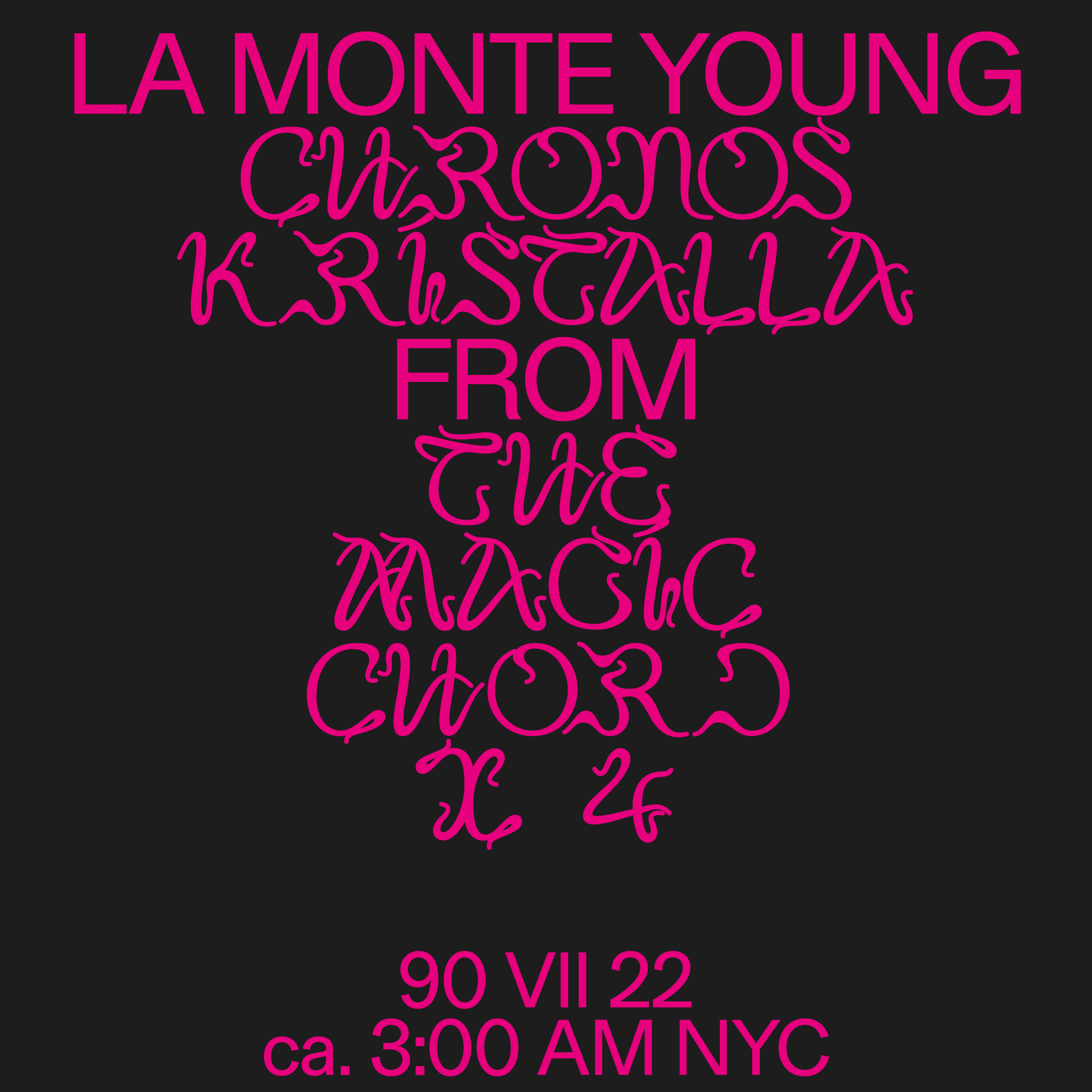
La Monte Young: Chronos Kristalla from The Magic Chord × 4
La Monte Young: Chronos Kristalla from The Magic Chord × 4
Bourse de Commerce - Pinault Collection
75001 Paris, France
La Monte Young
Chronos Kristalla
(Time Crystals)
from
The Magic Chord × 4
90 VII 22
ca. 3:00 AM NYC
New Version of Chronos Kristalla
for String Octet
20 IV 12
NYC
In a setting of
Dream Light
Marian Zazeela
Time Crystals Rippling Over the Magenta Ocean
Jung Hee Choi
The Theatre of Eternal Music String Ensemble
Led by Charles Curtis
Chronos Kristalla is a major composition for string quartet by legendary American avant-garde composer La Monte Young (b. 1935). Originally composed in 1989–90, and commissioned for the Kronos Quartet, this multi-hour spectacle of close tunings, haunting natural harmonics, and uncanny resonances received a handful of performances between 1990 and 1995. Despite its significance, no commercial recording of the piece exists, and the work has not been heard publicly for more than thirty years.
Chronos Kristalla draws on the pitches and just-intonation tunings of “The Magic Chord” from Young’s magnum opus The Well-Tuned Piano and transfers them to string instruments, opening a new dimension of continuity. Despite gradual changes in pitch, the listener experiences the piece as though situated within an immutable sound installation. Importantly, all of the performed pitches are played as flageolet tones—the naturally occurring partials of the instruments’ open strings. The ensuing richness of harmony vies with the immateriality of the timbre to create an otherworldly atmosphere, evoking the composer’s fabled first musical influence: the sound of wind blowing through the chinks between the logs of the cabin where he was born.
As Young has stated of his work with Marian Zazeela, “Our medium is time.” The title of Chronos Kristalla references Chronos, the Greek god of time, and suggests the crystallization of time from a steady flow into solidity and stillness. While the work itself continues to evolve over subsequent performances, this latest iteration of Chronos Kristalla doubles the instrumentation to further clarify the tunings and sustain longer durations. As in all of Young’s concert performance pieces, Chronos Kristalla will be performed in a lighting environment created by artist Marian Zazeela and now realized by Jung Hee Choi. The premiere of the octet version will also incorporate Choi’s light projection Time Crystals Rippling Over the Magenta Ocean.
La Monte Young (b. 1935) is a world-renowned composer, performer, and artist. For over sixty-five years, he has advanced durational musical composition, developed the technique of just intonation, and explored the psychological and phenomenological effects of precise tuning in physical sound environments. In the summer of 1958, Young composed the seminal work Trio for Strings, acknowledged as the first written work of musical minimalism. In 1962, Young, alongside his longtime collaborator and partner Marian Zazeela, formed the influential group The Theatre of Eternal Music and developed a radical performance practice that included as members himself, Zazeela, Terry Riley, Angus MacLise, Tony Conrad, and John Cale. In 1970, Young and Zazeela supported Indian master vocalist Pandit Pran Nath’s journey to the United States, eventually spending twenty-six years as his disciples in the Kirana style of Indian classical singing. In 1974, Young premiered his monumental, ongoing, improvisatory solo piano piece The Well-Tuned Piano (1964) in Rome on a specially tuned Bösendorfer piano. With the support of the Dia Art Foundation, Young and Zazeela built their most expansive version of Dream House—a sound and light environment at the former New York Mercantile Exchange building—where it was open to the public from 1979 to 1985. The MELA Foundation Dream House, built in 1993, remains open to the public in its permanent home at 275 Church Street, where Young still frequently performs his work, including with The Theatre of Eternal Music and The Just Alap Raga Ensemble, founded in 2002 with Zazeela and their senior disciple Jung Hee Choi.
Marian Zazeela (1940–2024) was an artist who worked in painting, drawing, graphic design, film, light projection, stage design, and sculpture. Beginning in the 1960s, she developed a singular visual language based on calligraphic iconography situated within highly saturated environments, in which light, color, sculptural form, and phenomenological effect feed into each other to create a total experience. Zazeela’s light environments and graphic design have formed the visual language of virtually all of her partner La Monte Young’s major output, from posters and records to the many iterations of the Dream House. Zazeela began singing with Young in 1962 as a founding member of The Theatre of Eternal Music, and she performed as vocalist in almost every concert of Young’s ensemble. In 1970, she became one of the first Western disciples of renowned master vocalist Pandit Pran Nath and later performed and taught the Kirana style of Indian classical music. She accompanied Pandit Pran Nath in hundreds of concerts throughout the world and also performed live with The Just Alap Raga Ensemble and The Sundara All Star Band, both of which she founded with Young and Jung Hee Choi. Zazeela’s Ornamental Lightyears Tracery has been credited as a major influence on Glenn Branca, David Sprague, and Andy Warhol’s Exploding Plastic Inevitable. In 2021 Zazeela was honored as one of the fourteen artists to receive the prestigious Anonymous Was A Woman Award in recognition of her significant contributions. Zazeela’s installations, works on paper, and performances have been presented by major American and European institutions, most recently at Dia Beacon from 2019–2022 and Artists Space in New York in 2024.
Jung Hee Choi (b. 1969) is a multimedia artist and musician based in New York, recognized for her series of environmental compositions, Ahata Anahata, Manifest Unmanifest—constellations of evolving light-point drawings, incense, sound, and performance. These environments, operating as living, intersubjective fields of vibration, are often noted by critics for their somatic impact and transcension from the discrete object. Choi received her MA in art and sound from New York University. She became a disciple of La Monte Young and Marian Zazeela in 1999, with the traditional Kirana gandha bandh red-thread ceremony taking place in 2003. As Young and Zazeela’s primary collaborator, Choi has participated in and directed the presentation of their installations and performances around the world. In 2002, she co-founded The Just Alap Raga Ensemble with Young and Zazeela. The three artists have performed together extensively since 2002, presenting live performances with their ensembles The Just Alap Raga Ensemble, The Sundara Trio, The Sundara All Star Band, and The Theatre of Eternal Music. Choi’s solo exhibitions were presented annually from 2009 through 2017 in the Dream House, where they were the only long-term installations other than their original environment. Since 2015, Choi’s works have been integral to the Dream House, where they have been presented simultaneously with Young and Zazeela’s works, forming a continuous and collaborative sound and light environment. Choi has exhibited and performed widely in the US, Europe and Asia, including at Casa del Lago UNAM, Dia Art Foundation, the Guggenheim Museum, Berliner Festspeile, FRESH Festival in Bangkok, FRAC Franche-Comté, and Bundeskunsthalle.
Charles Curtis (b. 1960) is among the foremost avant-garde cellists working today. A graduate of Juilliard, Curtis also studied just intonation, improvisation, and the Kirana style of Indian classical music under La Monte Young and the late master vocalist Pandit Pran Nath. He has since devoted much of his musical life to the realization and interpretation of Young’s work. Curtis has led numerous performances of Young’s compositions throughout Europe and the United States, including The Four Dreams of China, The Subsequent Dreams of China, and Trio for Strings. In consultation with Young, Curtis devised the just-intonation tuning for the original full-length version of Trio for Strings, premiered at the Dia Art Foundation Dream House in 2015 and released as a four-LP box set in 2021. Curtis is also one of only a handful of musicians to have appeared in duo formations with Young, performing Richard Maxfield’s Perspectives for La Monte Young for low string instrument and tape, and Terry Jennings’s Piece for Cello and Saxophone, which Young arranged expressly for Curtis. Since 2000, Curtis has taught at the University of California, San Diego, where he is now Distinguished Professor of Music. His recent recorded works include May 99 (Blank Forms Editions, 2022); Chamber Music: Alvin Lucier & Morton Feldman (Important Records, 2019) with Anthony Burr; and Éliane Radigue’s Naldjorlak (Saltern, 2023).