September 18–19, 2026
7:00pm doors; 7:30pm performance
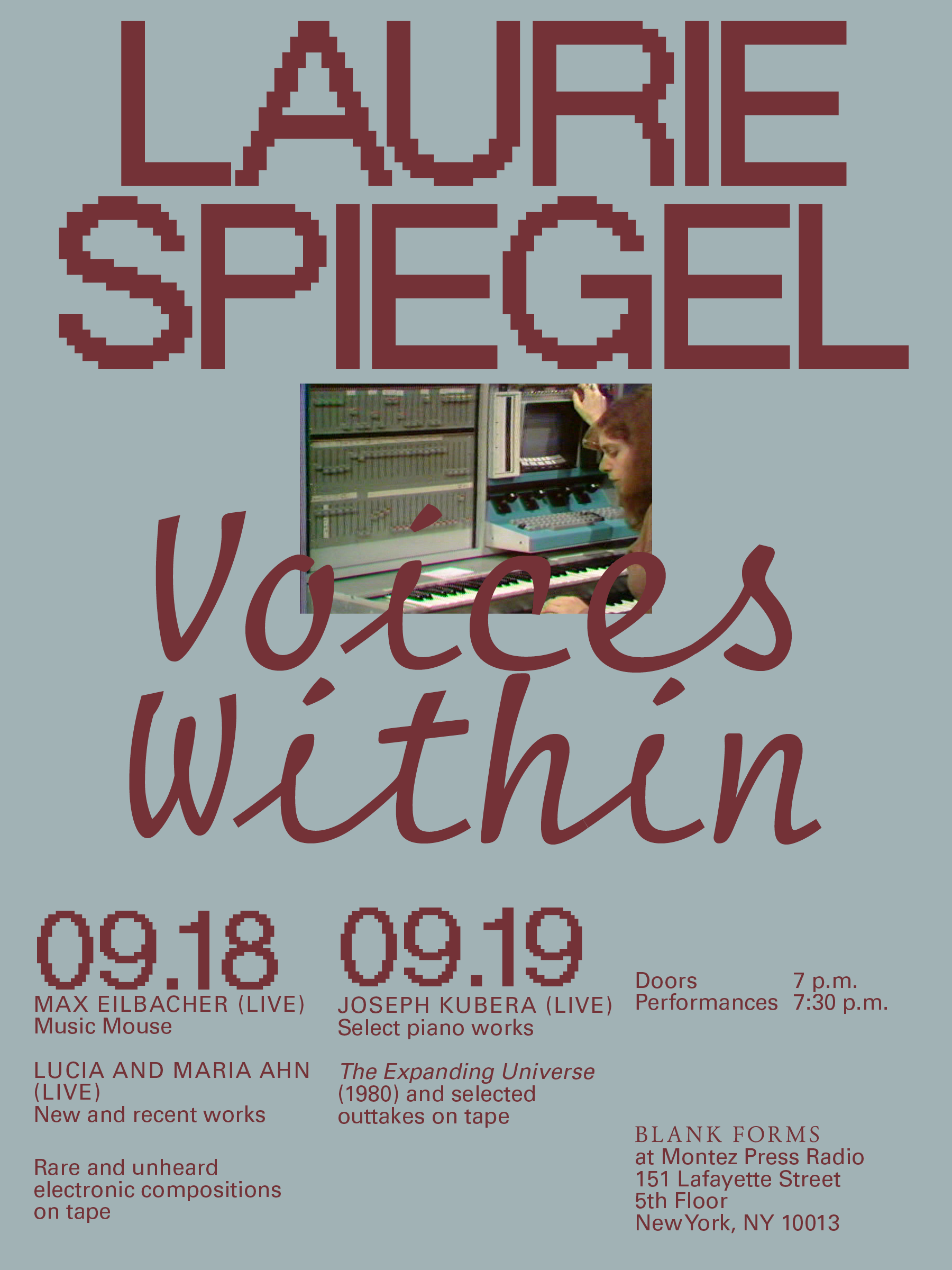
Laurie Spiegel: Voices Within
a portrait of the composer at eighty
Laurie Spiegel: Voices Within
a portrait of the composer at eighty
Montez Press Radio
5th floor
New York, NY 10013
$30 one night / $50 both (at door)
Laurie Spiegel first encountered analog synthesis in the late 1960s, when her professor Michael Czajkowski brought her to Morton Subotnick’s downtown New York studio, which was equipped with a Buchla 100. A first-year composition student at Juilliard, Spiegel was already resistant to an institutional culture of child prodigies, technical drills, and atonal composition in accordance with the intellectual aesthetic du jour. Her musical affinities lay elsewhere, with the social and emotional immediacy of folk practices such as jamming and improvisation and instruments like the banjo, guitar, and mandolin.
The Buchla offered Spiegel an unexpected extension of these interests. Working directly with sound, she could manipulate an orchestral scale of sonority in real time, without first transcribing an idea into notation or relying on performers to realize its constituent parts. Electronic music returned composition to the act of listening: an open-ended process of interacting with the technical and mechanical behavior of an instrument rather than working toward a predetermined result. The distinction between acoustic improvisation and electronic composition, in this sense, became increasingly beside the point.
This understanding of technology as an instrument of direct and intuitive music-making would remain central to Spiegel’s work. Beginning in 1973, she worked at Bell Labs with some of the earliest digital synthesizers, writing software in which computational systems became compositional partners rather than simply tools for executing fixed musical ideas. Her best-known program, Music Mouse (revived this year by Eventide in collaboration with Spiegel), translated the movement of a cursor across a two-dimensional field into complex harmonic relationships, allowing users to improvise with musical structures that might otherwise require considerable theoretical or instrumental training. Spiegel imagined related programs called Rhythm Rat and Counterpoint Chipmunk, though neither was ultimately realized.
Describing the computer as a kind of folk instrument, Spiegel was less interested in technological novelty than in what new technologies might return to the musician: immediacy, autonomy, and the possibility of making complex music without the institutional apparatus traditionally required to produce it. She composed much of her 1991 album Unseen Worlds with Music Mouse, using computational systems to develop works whose premises range from an infinitely self-generating composition, “A Harmonic Algorithm,” to “Viroid,” a melody derived from the nucleotide sequence of a strand of DNA.
With her insistently inventive output and intellectual, yet accessible, theories of composition, Spiegel has cemented her status as one of the founding figures of electronic music. Though she has largely retreated from public performance, her influence remains ubiquitous among artists running the gamut from the avant-garde to the commercial; it is difficult to imagine a modern electronic music that is not (at least implicitly) indebted to her bold explorations of the computational-musical form. In celebration of Laurie Spiegel’s eightieth birthday (just before she turns eighty-one), Blank Forms presents a two-night concert series surveying the myriad accomplishments of her long career. Night one will include rare and unheard tape recordings of Spiegel’s electronic compositions; performances with Lucia and Maria Ahn, interpreting earlier electronic works and premiering recent commissions for cello and piano; and a new commission from Max Eilbacher for Music Mouse. Night two will feature Joseph Kubera performing a selection of Spiegel’s rarely heard solo piano compositions, followed by a presentation of The Expanding Universe (1980) and selected outtakes.
Voices Within is organized by Lawrence Kumpf and Tommy McCutchon.
Montez Press Radio is located on the fifth floor of 151 Lafayette Street. There are three steps up from the street to the entrance; a passenger elevator is located immediately inside the front door. If you require help accessing the space or would like to use the nearby freight elevator, which opens directly onto the street, please contact izzy@blankforms.org.
This program is supported by mediaThe foundation.
