Martin Rev + Lary 7
Bourse de Commerce - Pinault Collection
75001 Paris, France
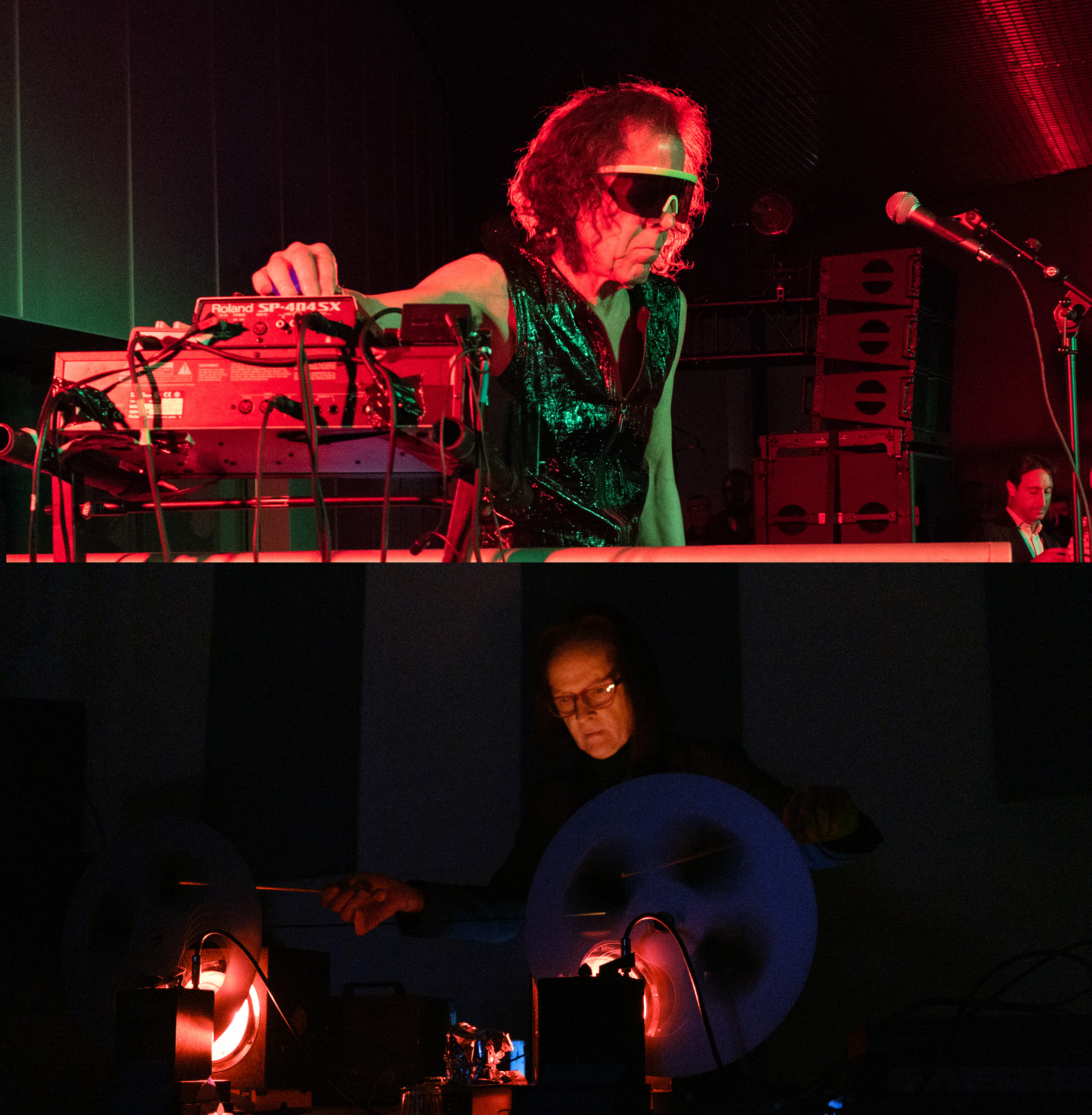
Lary 7 is an archaeologist of endangered media, working with residual technologies, scavenged machines, and obscure forms of technical knowledge to piece together the fragile conditions under which certain sounds can still be coaxed into existence. 7 treats obsolete audiovisual equipment as raw material, jury-rigging homemade instruments from tape machines, projectors, radios, motors, oscillators, and other refuse. He has referred to his sound-based performances as “irritainment,” an apt description for work that moves between abrasion, instability, humor, and moments of unexpected beauty.
As a filmmaker and multimedia artist, 7 approaches live presentation as a process of continual revision. When screening films, he may alter reels and projectors simultaneously, effectively re-editing the source material as it is being shown. In concert, he moves between his homemade devices, continually cajoling them into new formulations of light and noise. Empty reels spin, causing lights to strobe; feedback screeches; grating mechanical whistles give way to humming harmonies or bleating staccato blips. Across his decades-long practice, 7 has sustained an investigation into the sonic and graphic possibilities of misused technology, and particularly into the compounding effects of multiple machines operating in unstable relation. His East Village studio, Plastikville, is both workshop and archive: an autarkic, all-analog environment. Much of his work develops over long periods, remaining in process as component elements are continually edited, revised, dismantled, and recombined.
Born in Buffalo, 7 studied with Tony Conrad, Hollis Frampton, and the Vasulkas before moving to New York. His practice took shape in part through long hours spent in scrapyards, junk shops, and the surplus electronics stores of Canal Street, where he acquired equipment and components to reverse-engineer, modify, and set to unintended purposes. His work spans film, photography, music, performance, and installation, and has intersected with generations of artists and musicians including Jarboe, Pan Sonic, Jimi Tenor, Tom Verlaine, and Jutta Koether. For his performance at the Pinault Collection, his first European appearance in more than a decade, 7 will present an improvisatory set using a compact configuration of his homemade analog machinery.
*
As one half of Suicide (alongside Alan Vega), Martin Rev was among the first artists to describe their music as “punk.” But the duo’s confrontational expression of modern alienation—through Rev’s synthesizers, rhythm machines, and distortion—positioned Suicide equally as precursors to the no wave and electronic music of the seventies. Alongside his work with Suicide, Rev has maintained a prolific solo practice, moving between minimal electronics, distorted rhythm, spectral melody, and a strain of pop directness that runs throughout his work.
Growing up in New York in the 1950s and ’60s, Rev studied with Lennie Tristano and played in the city’s jazz scene, experiences that informed a compositional approach he has described as intensely visual. His music often unfolds as a field of contrasting textures: arpeggiated figures, washes of sustained tone, blunt percussion, and fragments of melody that surface and recede. But beneath his sawtooth waves, dense keyboards, and anxious drum-machine patterns is the lasting influence of doo-wop and R&B. Even his harshest passages often conceal a melodic core, with simple phrases bent out of shape by off-kilter chords, distortion, and filtering. His voice, when it appears, can be strikingly delicate against this backdrop. On Stigmata (2009), written in memory of his late wife Mari Reverby, hymnal, harplike textures support murmured vocals that hover between song and abstraction.
In Suicide, Rev reduced rock instrumentation to a stark electronic framework of keyboards, primitive rhythm machines, and feedback, creating the minimal structures over which Vega performed. His solo recordings extend that language in more expansive directions, foregrounding melody, harmony, and texture while retaining the physical force and economy that have defined his work for more than five decades. For his performance at the Pinault Collection, Rev will be joined by longtime collaborator VJ Divine Enfant, who will create a live visual accompaniment to his music.